

Making the Transsexual Visible
This Transgender Day of Visibility, learn to see the transsexuals erased and neglected by transgender people.

Introduction
The International Transgender Day of Visibility has come, and with that, an annual collective boom of transgender people shouting to the world, both the fact that they exist, and how they exist.
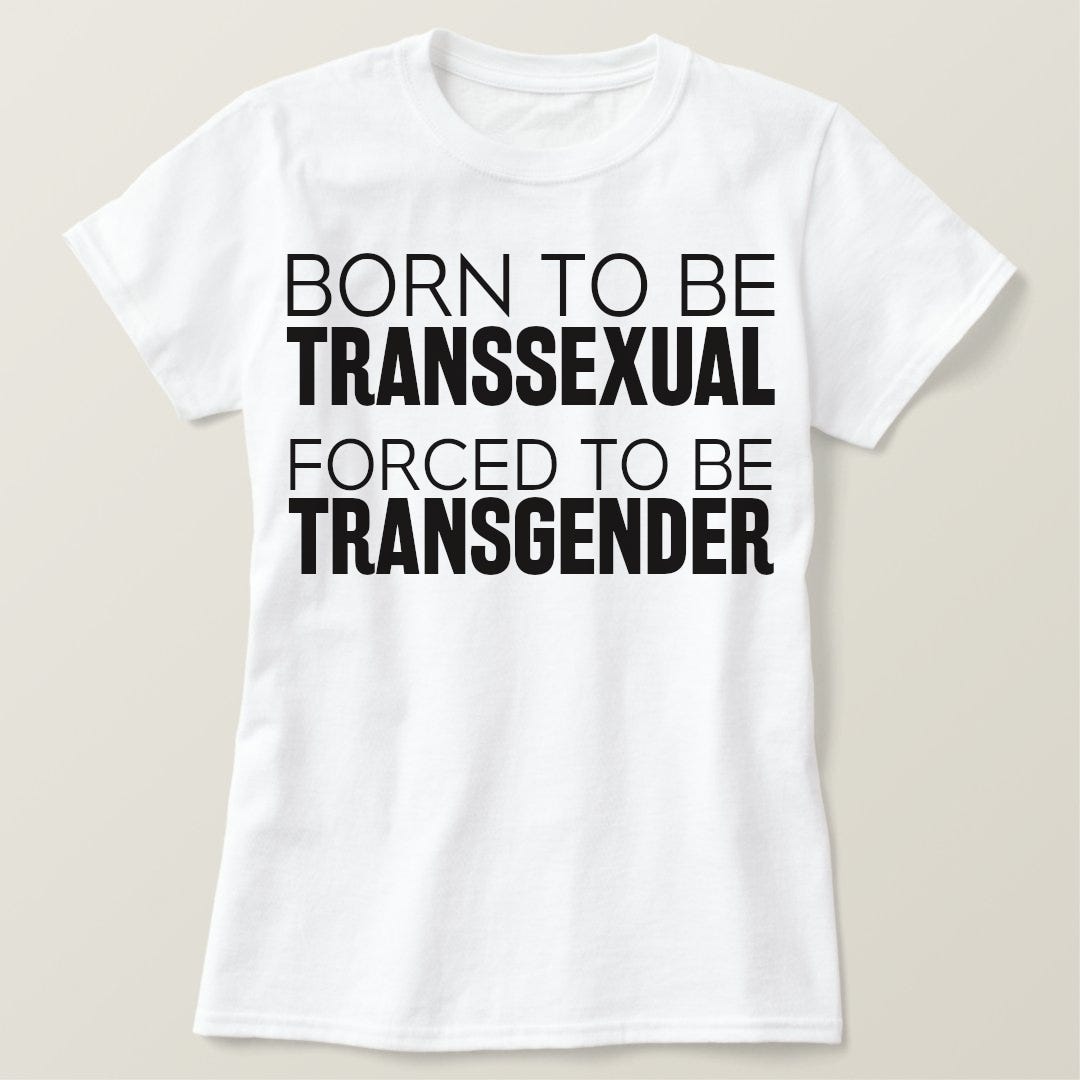
But here I am, sitting in the corner, being transsexual, not transgender. As I have consciously rejected the idea that I am “transgender”, instead finding “cisgender transsexual” more accurate for myself, I am chronically frustrated that people like me are so often erased, misdefined, and neglected by a community that’s supposed to speak on my behalf.
And if you’re lost on what I mean by “cisgender transsexual”, I say “Exactly my point; stay awhile and I’ll explain.”
This Transgender Day of Visibility, I’m adding to that trans-rights holler to demand nuance and a place for myself. It is my self-imposed duty to offer everyone interested in “transness” my perspective that is invisible today, to counteract the flattening and erasure routinely committed against us transsexuals.
Disclaimer
That being said, how I and people around me use transsexual and transgender is not the only way that these words get used. My article purely explains the specific definition and conceptualization that my immediate community uses.
The definitions and debunkings of misconceptions herein should be understood to be relative to how my immediate community conceptualizes transsexual and transgender people, and serve as strong recommendations for other communities to adopt the same use, not absolute mandates.
Background: gender identity as an identity
It is useful to start from a foundational reference work, in this case Whipping Girl by Julia Serano. Before distinguishing between the three terms transsexual, transgender, and trans, we must first refine our understanding of gender identity and acknowledge how this phrasing fails to capture the whole of our lived reality.
An identity is a sense of self that is bound to one’s existence through one’s conscious acknowledgement and self-expression. Serano points out that, for transsexuals, what is termed gender identity doesn’t feel like an identity, in the same way as (my examples) being Québécois, a Christian, or a Vegan might.
For example, a French Canadian born and raised in Montréal speaking Canadian French may not identify as Québécois (or Québécoise for women), because they don’t share the jingoistic enthusiasm for separatism from Anglophone Canada or making KFC change their name to PFK. As another example, someone who celebrates Easter and Christmas and believes in God and Jesus may not identify as Christian, because they don’t mesh with organized religion or the child abuse problem in many churches. And of course, someone who eats a diet free of all animal products might not identify as a Vegan, because the motivation for their diet comes from a dislike for meat and fish, instead of a struggle towards decarbonization, animal rights, or social justice. In each case, despite each person’s objective reality fitting the label, the attributes of the identity have diverged from those objective attributes.
Similarly, transsexuals typically don’t feel like their gender identity is an identity, but rather something innate to their existence, like being left-handed, being short, or having a mole on their cheek. As a transsexual woman, I feel that I am simply a woman in the same way that a cisgender cissexual woman usually has no reason to doubt whether she’s a woman.
I, for one, do not really pine for traditionally female dress or speech. My problem is that my body feels wrong for my brain somehow, because every time I realize I have bony hands, narrow hips, wide shoulders, a persistent 5-o’-clock shadow, and most crucially, a penis instead of a vagina, I fundamentally feel out of place in my own body, stuck with testosteronized features I can’t escape. This is what I mean with “I’m transsexual, not transgender, because my problem is that my sex, not my gender, isn’t right for what I am”.
As such, Serano splits gender identity into two concepts: gender identity proper and subconscious sex. And this new term is quite apt, as subconscious sex is another physical sex feature, a part of sex differentiation of the human body.
Background: cisgender transsexual and transgender cissexual
Finally we can build upon this foundational understanding, and modern distinctions made between transsexual and transgender, to explain what my preferred extended terms cisgender transsexual and transgender cissexual mean, and why I prefer to use them to describe two different groups of people within “the trans community”. I very intentionally call both groups “cis-something trans-something”, in order to avoid the knee-jerk accusation that I’m “calling trans people cis”: I’m calling myself cisgender, and besides, there’s nothing wrong with being cis or trans.
Cisgender transsexuals are people whose subconscious sex clashes with other sex features (and Serano terms this sex incongruity) significantly enough for them to medically benefit from transitioning (i.e. transsexual), but do not identify any differently from their subconscious sex (i.e. cisgender). Just as, in general, men have broad shoulders, large hands, narrow hips, and a penis, men have a male subconscious sex. (Does this mean that transsexuals are intersex by definition? That’s a thought-provoking digression for another day.)
The direct counterpart to that concept is transgender cissexual. Transgender cissexuals are people whose gender identity differs from their subconscious sex (i.e. transgender), but do not experience sex incongruity, or not significantly more than cis people (i.e. cissexual), as exemplified by trans people who claim to be non-dysphoric trans people.
This separation is not an invalidation. Neither group is deemed “better” or “more real” (well, besides “closer to the lived experience of this article’s author”). Besides, as far as I know, the affirmations that “you don’t need to transition to be valid” and “you don’t need dysphoria to be trans” are central to validity rhetoric, so defining the term in a way that assumes that they don’t need to transition should pose no problem.
Separating cisgender transsexuals from transgender cissexuals does not “divide the trans community” any more than separating housecats from lions “divides felines”. We can learn about the behavior of housecats in analogy with that of lions, or vice versa, but on the other hand, calling them both felines flattens important differences about their respective history, background, behavior, and other features. Analogously, separating these two types of trans people avoids falsely universalizing the transgender cissexual experience, and allows us to understand all trans peoples more deeply and clearly. Accurate categorization can reduce infighting by reducing false universalization.
However, I observe often that transgender cissexuals feel like their gender identity is an identity in the same sense as being Québécois, Christian, or Vegan is an identity, and tend to project this onto cisgender transsexuals. This lack of awareness that there are different kinds of trans people is a hidden impulse that drives many of these misunderstandings of what it means to be transsexual.
“Transgender or trans are replacements or improvements for transsexual”; “transsexual is offensive”
Right off the bat, I must dispel the assertion that transsexual is outdated or offensive compared to transgender or trans. This assertion is widespread across “transgender” activist groups, dictionaries, and LGBT styleguides like GLAAD, yet it falls short of the truth. It takes many forms ranging from misunderstandings to even bigotry, whether intentionally or through a subconscious bias.
A milder form of transsexual erasure that I often encounter from well-meaning trans people and allies is the “politeness” version: that transsexual is outdated or offensive and should be replaced with transgender or trans. While I understand that the word transsexual has pathologizing origins like homosexual, and continue to feel “icky” for some, ironically it’s exactly this medical history that people like me prefer.
It should be noted that transgender arose as a term to describe gender-diverse people other than transsexual. Serano points out that transgender traditionally contained people who today probably wouldn’t be considered trans by many, such as drag queens, crossdressers, and butches, and that trans was the umbrella term that combined them for political leverage. The reason why the prefix trans- came to stand on its own is precisely because transsexual and transgender mean different things, yet people wanted to talk about both at once. (Whether or not this worked out for us is another digression for another occasion.)
A related misconception is asserted in the Wikipedia article for Transsexual:
The term transsexual is a subset of transgender, but some transsexual people reject the label of transgender.
The claim that transgender includes transsexual is ahistorical as well as incorrect.
A worse expression is the “slur” version: claiming that transsexual is somehow a slur on the same level as “the T-slur”, “the gay F-word”, or “the sapphic D-word”. This argument erases those who identify as transsexual for these previously stated reasons, and also makes light of actual slurs. A slur is a word whose intent to offend is embedded within the definition of the word. For example, while slow may be used to abuse those with mental development disabilities, it is not an ableist slur but an adjective that a preschooler learns. Transsexual has been fished out from the black lagoon of pathologization and ameliorated (= in linguistics, had its negative connotation lessened), as that pathologization waned in the public’s consciousness.
The most destructive type is the “wild accusation” version: accusing strangers saying transsexual instead of transgender of having undesirable worldviews, like a shibboleth. Some call us out as “exclusionary”, simply for asserting our distinctly transsexual lived reality. Others are more indiscreet and call us “TERFs” or “transmeds” or “cis bootlickers”.
While it is understandable that people who aren’t personally transsexual may feel invalidated by hearing the word, it is simply the case that transsexuals are transsexual, and those who aren’t are not. In other words, whether some other person in your trans community identifies as transsexual has no bearing on whether you personally must identify as transsexual.
I find that these accusations are a display of “obstinate or narrow-minded adherence to one’s own opinions and prejudices”, which is the Merriam–Webster definition of bigotry. Anyone who lobs this accusation has walked the road to transsexual erasure Hell, paved with the good intentions of transgender advocacy.
“Transsexual means transitioning”; “transsexual means transitioned”; “transsexual means wanting to transition”
This is a misconception committed by Wiktionary and Wikipedia:
(dated) Of a person, having changed, or being in the process of changing, physical sex by undergoing medical treatment, such as hormone replacement therapy (HRT) and/or optionally sex reassignment surgery (SRS). —Wiktionary
A transsexual person is someone who experiences a gender identity that is inconsistent with their assigned sex or gender, and desires to permanently transition to the sex or gender with which they identify, usually seeking medical assistance (including gender affirming therapies, such as hormone replacement therapy and gender affirming surgery) to help them align their body with their identified sex or gender. —Wikipedia
It is even committed by LGBT style guides like GLAAD and by doctors, such as by the writer of the following quote (author Pallavi Suyog Uttekar MD and reviewer John P. Cunha, DO, FACOEP; neither of whom have any history of working with gender transition).
“Transgender people have a gender identity or expression different from their sex assigned at birth. Transsexual refers to those who have permanently altered their bodies through medical interventions to align with their self-identified gender.”
Whether someone has the desire or opportunity to undergo medical transition is of no relevance to whether that person has the medical justification to do so. Even those whose quality of life stands to benefit from transitioning often cannot transition, for reasons such as cost, pre-existing health issues, lack of availability or legality in their country or region, and an unsupportive environment. Transsexual is an ontological (i.e. related to existence, things that exist, or things defined as existing) concept that is measurable by symptoms or a history thereof; transsexual is not about bodily alterations. Defining transsexual by the privilege of having transitioned is gatekeeping.
In other words, transsexual isn’t about physical transition. It isn’t about social transition, either. It’s about whether one needs to transition, and why.
Digression: transition and bodily autonomy
This want–need conflation is closely linked to the related misconception that “transition is a bodymod” or “transition is about bodily autonomy”. Some people who claim to advocate for medical transition for everybody co-opt the Pro-Choice “bodily autonomy” argument to argue that everybody who wants to medically transition should be able to do so, like with tattoos and piercings. This fundamentally neglects to understand why transsexuals transition.
The first problem is that medical transition is healthcare that is performed in order to improve someone’s quality of life, not a medically-unnecessary bodymod that is performed in order to boost someone’s self-esteem or feed their vanity.
Doing the same thing with the same tools can be very different acts. Anesthesia is very different from recreational opioid use. Cooking is very different from committing a stabbing. Jumping off a cliff to dive is very different from jumping off a cliff to die. In the same way, using hormones to treat a symptom, whether related to sex dysphoria, menopause, or baldness, is very different from using hormones to change someone’s gender expression, as DIY advocates tend to say is why everyone transitions.
Comparing transition to abortion slightly complicates this first problem. Of all the abortions, many are performed because they are medically necessary, but some others are performed as a result of rape or “poor family planning”. The “bodily autonomy” argument for abortion seems to be tailored towards states and regions that allow abortions in cases where it’s medically necessary, forcing women to carry all other pregnancies until birth or miscarriage. Unlike that, much of the world lives in areas where transition is not even allowed or easily accessible when it is medically necessary, so borrowing the bodily autonomy argument for transition is, to put it politely, a couple decades too soon.
The second problem is that framing medical transition as a want instead of a need causes the medical argument to be less convincing.
People who have chosen to transition under informed consent without having dysphoria to treat forget that informed consent is a product of campaigning for better availability of transition healthcare, for those locked out by a lack of capacity. The slogan wasn’t “my body, my choice” but “healthcare is a human right”. As the tide is now reversing in the US against granting more “trans rights” (as Pew Research Center’s polling from 2017 to 2022 and again from 2022 to 2025 shows), abandoning the framing that transsexuals need to transition is a blunder that could make transition in general a thing of the past, resigning it into the space of “on your own time, on your own money”.
The third problem is that hormone replacement has too many delicate and drastic side effects to monitor, that it should not be attempted without regular medical check-ups. Some transition advocates claim that “transition has no side effects” or “transition is reversible”, which are absurd claims, as it has as many side effects as birth control, many of which permanent; and of course it would, because both act to destabilize hormonal homeostasis (i.e. the body’s function to keep itself in a stable state). This is in stark contrast to piercings, whose post-operation procedure basically boils down to “don’t get it infected”.
I would dare say that promoting DIY HRT (at least, doing so to discredit or replace medical transition) is a reckless act towards others’ health, in addition to a show of privilege that assumes that people can just afford to legally buy hormones from abroad.
If you do not experience sex incongruity, I implore you not to transition through the medical system. Triaging—reserving limited medical resources for those who need them the most—is an important part of medicine, no matter how soul-crushing that responsibility is for the practitioner.
“Transsexual is about sex, which is about genitals”
Some people excessively focus on genitals when defining transsexual. Human sex differentiation has many individual features, and genitals are but one of the many partially correlated axes. In fact, genitals are multiple of these axes, because the external appearance of the genitals and the reproductive functionality of these genitals are not always equal.
One form that this takes is “a transsexual has undergone The Surgery, and a transgender person hasn’t”, which is gatekeeping by opportunity, as previously described.
Another form that I also see is “a transsexual experiences genital dysphoria, while a transgender person doesn’t”, which oversimplifies the complex nature of sex dysphoria that transsexuals experience: while many transsexuals do experience genital dysphoria, different transsexual individuals find different individual sex features more or less distressing. The through-line is that the distress is there and medically significant.
“Transsexual requires dysphoria”; “Transgender includes gender euphoria while transsexual doesn’t”
Some people criticize this dysphoria- and medical-centric conceptualization as not being inclusive enough of transgender people who don’t experience any gender dysphoria. Besides distinction not being the same thing as discrimination, these critics often oversimplify or misunderstand what it means to be transsexual or to have dysphoria.
One oversimplification is about how consistent, persistent, or debilitating the dysphoria has to be. I have heard people strawman us as thinking that “you have to want to kill yourself all the time” to be transsexual. In reality, it is not only possible but quite common for us to live through sex dysphoria, or momentarily find relief in a particularly good passing experience. That relief is called gender euphoria.
The experience of gender euphoria is only possible if there is dysphoria to be relieved from. That is what people mean with “gender euphoria is evidence of gender dysphoria”, and with “there is no gender euphoria without dysphoria”. That is also why people who claim that they are transgender with “only gender euphoria” are either not transsexual or desensitized to their gender dysphoria over the years.
In conclusion, to be transsexual means to have sex incongruity, as evidenced by the presence of gender dysphoria, or having had it prior to transition. As long as the gender dysphoria is present in an amount and frequency that affects the person’s quality of life, it doesn’t have to be debilitatingly strong or constant in every waking moment.
“Transsexual is nonbinary-exclusionary”
Some people assume that the dysphoria-centric conceptualization of transsexual means that nonbinary people cannot be transsexual. This is a misunderstanding.
It is related to the false stereotype of transmedicalists (i.e. those who conceptualize transness in terms of medical treatment of dysphoria) being nonbinary-exclusionary. As evidenced by a user survey of /r/Truscum (“truscum” meaning the somewhat-reclaimed pejorative [i.e. a word with an insulting connotation] for transmedicalists), the majority of transmedicalists believe that nonbinary people are real and legitimate.
As the conceptualization of transness by transmedicalists maps pretty neatly to transsexual, it is reasonable to consider that a nonbinary transsexual is not a contradiction, at least in theory. Someone may experience dysphoria towards the sex features of both binary genders.
This is not to say that all nonbinary people are necessarily transsexual, nor that they are all transgender. This is simply based on the definition of nonbinary: “being neither man/male nor woman/female”.
Digression: transfem and transmasc, vs. trans woman, trans man, and nonbinary transsexual
Speaking of contradictions, I feel that I must interject on—in my opinion—an incoherent usage of transfem and transmasc. In my understanding, transfem is short for transfeminine, someone who is transsexual or transgender and seeks to make their sex or gender more feminine, and transmasc is the same with masculine.
However, there are certain people deep in the trans community who claim the existence of such things as AFAB transfems and AMAB transmascs. For those who don’t know, AFAB and AMAB are short for assigned female at birth and assigned masculine at birth respectively, and is a shorthand for a female physical sex or a male physical sex, at least observed at birth. As such, AFAB transfems and AMAB transmascs are oxymorons that, even if applied to nonbinary people, misgender them in one way or another.
The idea that approaching their AGAB makes someone trans is incoherent to me; that would open the door to considering anyone who pursues cosmetic surgeries trans, if the result is relevant to sex features, even without leaving the person’s sex/gender category. This means that the set of all trans people would have to include men who seek height increases or prevention of balding, and women who seek permanent hair removal or Mar-a-Lago Face. This is clearly not how trans is used in most real-life contexts.
As it is completely natural for trans people to want to pass, it’s also completely natural for cis people to want to pass; this doesn’t make them transsexual.
“-Sexual is for sexualities, so stop saying transsexual”
This one is mainly said by ignorant cis people, but I’ve also heard this once from a transgender person as a reason why nobody should say transsexual anymore. This is an etymological fallacy.
An etymological fallacy consists of citing a term’s etymology, real or folk, and prescribing incorrectly what it means. An example of an etymological fallacy is the “urinal cakes are cakes” retort, used by transphobes as a slogan against “trans women are women”, to imply that they aren’t. In this specific case, the argument ignores one definition of cake in the context of urinal cake, “a block of dense material”, to impose a different one in an unrelated context as in chocolate cake, “a dessert made of flour, sugar, and eggs and baked in an oven”. There is nothing that prevents multiple definitions of cake to exist in different contexts, including the context in which cake refers to buttocks.
The etymological fallacy in “-sexual is for sexualities” lies in the observation that not all sexuality terms end in -sexual, and not all terms ending in -sexual are a sexuality term. Examples of sexuality terms that don’t end in -sexual are straight, gay, lesbian, achillean (synonym of gay: of men attracted to men), and sapphic (synonym of lesbian: of women attracted to women). Example of terms ending in -sexual that aren’t sexualities are psychosexual (i.e. relating to the psychology of sexual attraction) and chemosexual (i.e. relating to the chemical compounds relevant to sexual attraction). There is nothing that necessitates that transsexual be a sexuality today.
Conclusion
To a transsexual like myself, the International Transgender Day of Visibility rings hollow, because all its advocacy does little to further the visibility or understanding of transsexuals, whether within trans communities or without.
On March 31 this year and onward, I implore everyone to see the transsexual. I implore you to seek out the distinct existence and needs of the transsexual, routinely marginalized by transgender-centric trans advocacy. I implore you to remember that we’re still here. Those of us whose lives are marred by sex incongruity. Those of us who never consciously desired to transition but psychologically needed to. Those of us for whom our transness is not an identity but a state of being. Those of us who proudly call ourselves transsexual instead of transgender.
...I’m stuck in this corner and I can’t get out. Can you lend me a hand?
Footer

I’m Haley Walker a.k.a. Haruki Wakamatsu, a Japanese transsexual woman with so many opinions. I am the sole writer for Haley’s Musings, my personal blog where I post my long-form thoughts about how trans people are treated and understood today, both from within the trans community and without.
This article was published 2026 March 31 (Japan time), on the Transgender Day of Visibility.